

Homenumental House Infoguide by Homehearted most homeowners hit the same wall. They search online for guidance, find dozens of conflicting articles, and walk away more confused than before. Some tips push expensive renovations. Others bury simple fixes under technical language. What people actually need is one clear and honest guide that covers the full picture of running a home from design and maintenance to safety and smart upgrades.
That is exactly what the Homenumental House Infoguide by Homehearted delivers. It is not a trend forecast or a design magazine. It is a practical system built around how real people live, how homes actually work, and what decisions matter most at every stage of homeownership.
Whether you are moving into your first home, planning a renovation, or simply trying to stay ahead of repairs, this guide gives you the structure to move forward with confidence.
What is the Homenumental House Infoguide

The Homenumental House Infoguide by Homehearted is a structured home improvement and lifestyle guide that helps users understand:
- Home design and layout planning
- Room-by-room functionality
- Budget-friendly renovation ideas
- Storage and organization systems
- Maintenance routines and home care habits
Its main goal is to remove confusion from home improvement by giving clear, step-by-step guidance instead of overwhelming options.
What Makes This Infoguide Different from Other Home Guides
Most home improvement content falls into one of two categories. It is either too vague to be useful or too narrow to cover your actual situation. The Homenumental House Infoguide by Homehearted fills the gap in between.
| Feature | Most Competitor Guides | Homenumental House Infoguide |
|---|---|---|
| Room-by-room breakdown | Rarely included | Fully covered |
| Seasonal maintenance calendar | Often skipped | Month-by-month system |
| Home documentation system | Not addressed | Detailed guidance included |
| Budget planning per project | Generic estimates only | Actionable cost framework |
| Safety checklist | Mentioned briefly | Room-specific safety checks |
| Smart home integration tips | Trend-based only | Practical upgrade advice |
| Renovation red flags | Ignored | Clearly explained |
| Renter vs owner guidance | Not distinguished | Both perspectives covered |
The Core Principles Behind Homenumental Living
Before diving into specific rooms or projects, it helps to understand the philosophy this guide is built on. Homenumental living is not about having a perfect home. It is about having a home that works well for you.
- Function comes first. A home should make daily life easier not harder.
- Every space needs a purpose. Rooms without clear intent become wasted space.
- Style should reflect the people who live there not current magazine trends.
- Maintenance is not optional. A beautiful home that goes unmaintained deteriorates quickly.
- Planning saves money. Most costly mistakes happen when homeowners skip the planning phase.
These principles are not rules. They are a framework that helps you make better decisions at every stage from choosing paint colors to hiring a contractor.
Step One: Document Your Home Before Doing Anything Else
This is the step most homeowners skip and later regret. Before you plan a renovation, update a room, or call a repair service, build a master home document.
A complete home record should include the following:
- Room dimensions for every space in the home
- Flooring type and brand in each room
- Paint colors with exact brand name and finish
- Appliance model numbers and purchase dates
- Warranty details for appliances and major systems
- Contractor names and contact information
- Permit records for any completed work
- Photos of all major systems including electrical panels, plumbing shut-offs, and HVAC units
- Insurance policy numbers and renewal dates
This document turns reactive homeownership into proactive homeownership. When something breaks you have the information you need before you even make the first call.
Room-by-Room Planning Guide
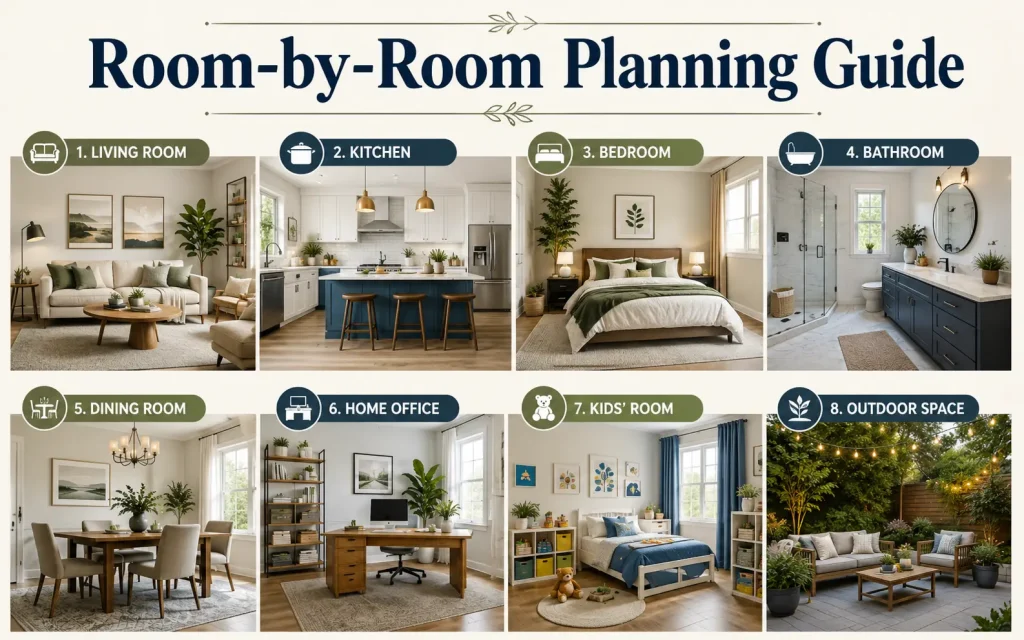
Each room in your home serves a different purpose and requires a different approach to design, organization, and maintenance. Here is how to approach each major space.
Living Room
The living room is where family life happens. Good design here balances comfort, flow, and visual calm.
- Choose furniture that allows easy movement around the room. Aim for at least 36 inches of walkway between pieces.
- Anchor the room with a neutral base on walls and larger furniture. Add color through cushions, rugs, and art.
- Lighting should include three layers: overhead, task, and accent. A single ceiling light is never enough.
- Declutter regularly. Storage ottomans and built-in shelving solve most living room organization challenges.
Kitchen
The kitchen is the most used and most expensive room to renovate. Approach it with a plan.
- The work triangle between sink, stove, and refrigerator should have no obstructions.
- Cabinet hardware wears out faster than the cabinets themselves. Replacing handles and hinges is a low-cost way to refresh the space.
- Under-sink plumbing should be checked twice a year for slow leaks. Early detection prevents floor and cabinet damage.
- Ventilation matters. A range hood that vents outdoors removes grease, moisture, and odors that degrade air quality.
Bathroom
Bathrooms combine plumbing, ventilation, and moisture management in a small space. Small problems escalate quickly here.
- Grout and caulk around the tub and shower should be inspected annually and resealed as needed.
- A bathroom exhaust fan should be run during and for 15 minutes after every shower to prevent mold.
- Water pressure problems often start at the aerator on faucets. Cleaning or replacing aerators costs almost nothing.
- Storage in small bathrooms improves dramatically with vertical shelving and over-door organizers.
Bedroom
Bedrooms exist for rest. Design choices here should support sleep quality and morning efficiency.
- Blackout curtains improve sleep quality and are one of the highest-impact low-cost upgrades in any bedroom.
- Closet organization systems prevent the creep of clutter into the rest of the room.
- Temperature between 60 and 67 degrees Fahrenheit supports better sleep according to sleep research.
- Keep electronics and screens out of the sleeping area when possible.
Garage and Utility Spaces
These spaces are often last on the list but first to cause problems when ignored.
- Garage floors should be sealed to prevent moisture absorption and cracking.
- Utility rooms need clear access to water shut-offs, circuit breakers, and HVAC filters at all times.
- HVAC filters should be replaced every 60 to 90 days in most homes. Homes with pets or allergies may need monthly replacement.
- Dryer vents should be professionally cleaned at least once per year. Clogged vents are a leading cause of house fires.
Seasonal Maintenance Calendar
Home maintenance becomes manageable when it follows a predictable calendar. Here is a practical seasonal breakdown.
| Season | Key Maintenance Tasks |
|---|---|
| Spring | Inspect roof for winter damage. Clean gutters. Service air conditioning unit. Check window and door seals. Test smoke and carbon monoxide detectors. |
| Summer | Check attic ventilation. Inspect irrigation systems. Clean dryer vent. Inspect deck or patio for loose boards or fasteners. Power wash exterior surfaces. |
| Fall | Clean gutters again after leaves fall. Winterize outdoor faucets. Inspect heating system and replace filter. Seal driveway cracks before frost. Test sump pump. |
| Winter | Monitor for ice dams on roof. Keep cabinet doors under sinks open during freezes. Check insulation in attic and crawl spaces. Test all smoke detectors again. |
Home Safety Checklist: What Most Guides Leave Out
Safety is often treated as a footnote in home guides. This section treats it as a priority.
Fire Safety
- Smoke detectors should be installed on every level of the home and inside each bedroom.
- Test smoke detectors monthly. Replace batteries annually unless the unit has a 10-year sealed battery.
- Keep a fire extinguisher in the kitchen and garage. Check the pressure gauge twice per year.
- Create and practice a home fire escape plan with all household members.
Carbon Monoxide Safety
- Carbon monoxide detectors are required on every level of homes with fuel-burning appliances or attached garages.
- Never run a car engine, generator, or grill inside a garage even with the door open.
- Have gas appliances inspected by a licensed professional every two years.
Electrical Safety
- Outlets near water sources should be GFCI protected. Test them monthly using the test button.
- Avoid overloading extension cords or power strips with high-draw appliances.
- If breakers trip frequently call an electrician. This is not a normal occurrence.
- Aluminum wiring in homes built before 1973 requires inspection by an electrician familiar with its specific risks.
Water and Flooding
- Know exactly where your main water shut-off valve is located and confirm it turns freely.
- Install water sensors under sinks, behind refrigerators, and near water heaters.
- Grading around the foundation should slope away from the home at six inches per ten feet.
Budget Planning for Home Improvement Projects
Cost overruns are the number one frustration homeowners report after any renovation. The solution is a realistic budget built before the project starts.
| Project Type | Typical Cost Range USA | Common Budget Mistakes |
|---|---|---|
| Kitchen remodel full | $25,000 to $75,000 | Underestimating labor and permit costs |
| Bathroom remodel | $8,000 to $30,000 | Choosing finishes before knowing structural costs |
| Roof replacement | $7,000 to $20,000 | Delaying until damage is severe |
| HVAC replacement | $5,000 to $12,000 | Buying oversized units for the space |
| Flooring replacement | $3,000 to $10,000 | Not accounting for subfloor repairs |
| Fresh interior paint | $2,000 to $6,000 | Skipping primer and proper prep work |
| Landscaping update | $1,500 to $8,000 | Choosing plants unsuited for the climate |
A standard rule in home improvement is to add 15 to 20 percent to any estimate as a contingency. Unexpected costs are not the exception. They are the rule.
Smart Home Upgrades Worth Considering

Smart technology has become more accessible and genuinely useful. These upgrades offer real value rather than novelty.
- Smart thermo stats reduce heating and cooling costs by an average of 10 to 15 percent annually according to the U.S. Department of Energy. Installation is straightforward for most homeowners.
- Smart water leak detectors send alerts to your phone the moment moisture is detected. They cost between 20 and 50 dollars each and can prevent thousands in water damage.
- Video doorbells improve security and provide documentation for package deliveries and visitor activity.
- Smart plugs allow you to remotely control and schedule any standard outlet. This is useful for lamps, fans, and electronics left on accidentally.
- Whole-home air quality monitors track particulate matter, carbon dioxide, humidity, and volatile organic compounds. Good air quality directly affects health and sleep.
When adding smart devices, prioritize those connected to a single app or ecosystem to avoid managing multiple platforms.
Renovation Red Flags Every Homeowner Should Know
Knowing when to stop a project or walk away from a contractor saves money and prevents serious problems. Watch for these warning signs.
| Red Flag | What It Could Mean | What to Do |
|---|---|---|
| Contractor requests full payment upfront | Potential scam or cash flow problem | Never pay more than 30 percent upfront |
| No permit pulled for major work | Unlicensed work or code violations | Require permits for all structural and electrical work |
| Musty smell in walls or floors | Hidden mold or moisture problem | Call a mold inspector before proceeding |
| Walls that feel soft or spongy | Water damage or rot behind drywall | Investigate before covering with new materials |
| Flickering lights across multiple rooms | Electrical panel or wiring issue | Call a licensed electrician immediately |
| Estimate far below all others | Corners likely to be cut on materials or labor | Ask for detailed breakdown before accepting |
Home Guidance for Renters: You Have More Power Than You Think
Most home guides focus entirely on homeowners. But renters make up a significant share of households and face their own set of challenges. The Homenumental House Infoguide by Homehearted addresses both.
- Document the condition of your rental unit with photos and video on the day you move in. Send the documentation to your landlord in writing.
- Request all maintenance commitments from your landlord in writing. Verbal agreements are difficult to enforce.
- Most renters can make non-permanent improvements such as removable wallpaper, peel-and-stick tiles, and tension rod organizers without violating lease terms.
- Learn to identify signs of mold, water leaks, and pest activity. You have the legal right to a habitable living environment in every U.S. state.
- Renters insurance costs between 15 and 30 dollars per month and covers personal belongings, liability, and temporary living costs if the unit becomes uninhabitable.
Building a Home That Works for Your Life
A home is not a finished product. It is a living system that changes as your life changes. Children grow up. Families expand. People age in place. Work habits shift. The home that worked five years ago may need to adapt to serve you well today.
The Homenumental House Infoguide by Homehearted is designed with that reality in mind. It does not offer a single vision of what a home should look like. It gives you the tools to build the home that works for your life right now and the framework to adjust it as your needs evolve.
Start with documentation. Move into seasonal maintenance. Plan your projects with realistic budgets. Address safety before aesthetics. Make smart upgrades that solve real problems. And approach every room with the question: does this space make my daily life easier?
When your home answers yes to that question in every room, it is doing its job.
FAQs
What is Homenumental House Infoguide by Homehearted?
It is a comprehensive home improvement and lifestyle guide designed to help homeowners improve design, comfort, and functionality in their living spaces.
Who should use this infoguide?
Anyone interested in home improvement, interior design ideas, or practical household organization tips can benefit from it.
Does the guide include interior design ideas?
Yes, it covers interior styling suggestions, layout improvements, and decor inspiration for modern homes.
Is Homenumental House Infoguide beginner-friendly?
Yes, it is written in a simple and practical way, making it easy for beginners to understand and apply ideas.
Can this guide help increase home value?
Yes, many tips focus on upgrades and improvements that can enhance both aesthetics and property value.
Final Thought
Homenumental House Infoguide by Homehearted is a practical and inspiring resource for anyone looking to improve their living space without unnecessary complexity. Whether you are planning small upgrades or a complete home transformation, this guide offers useful ideas that balance style, comfort, and functionality.
By applying the tips and concepts shared in the guide, homeowners can create a more organized, visually appealing, and value-enhanced environment that truly feels like home.
It May Also Like It:
How to Lose a Guy in 10 Days Yellow Dress