
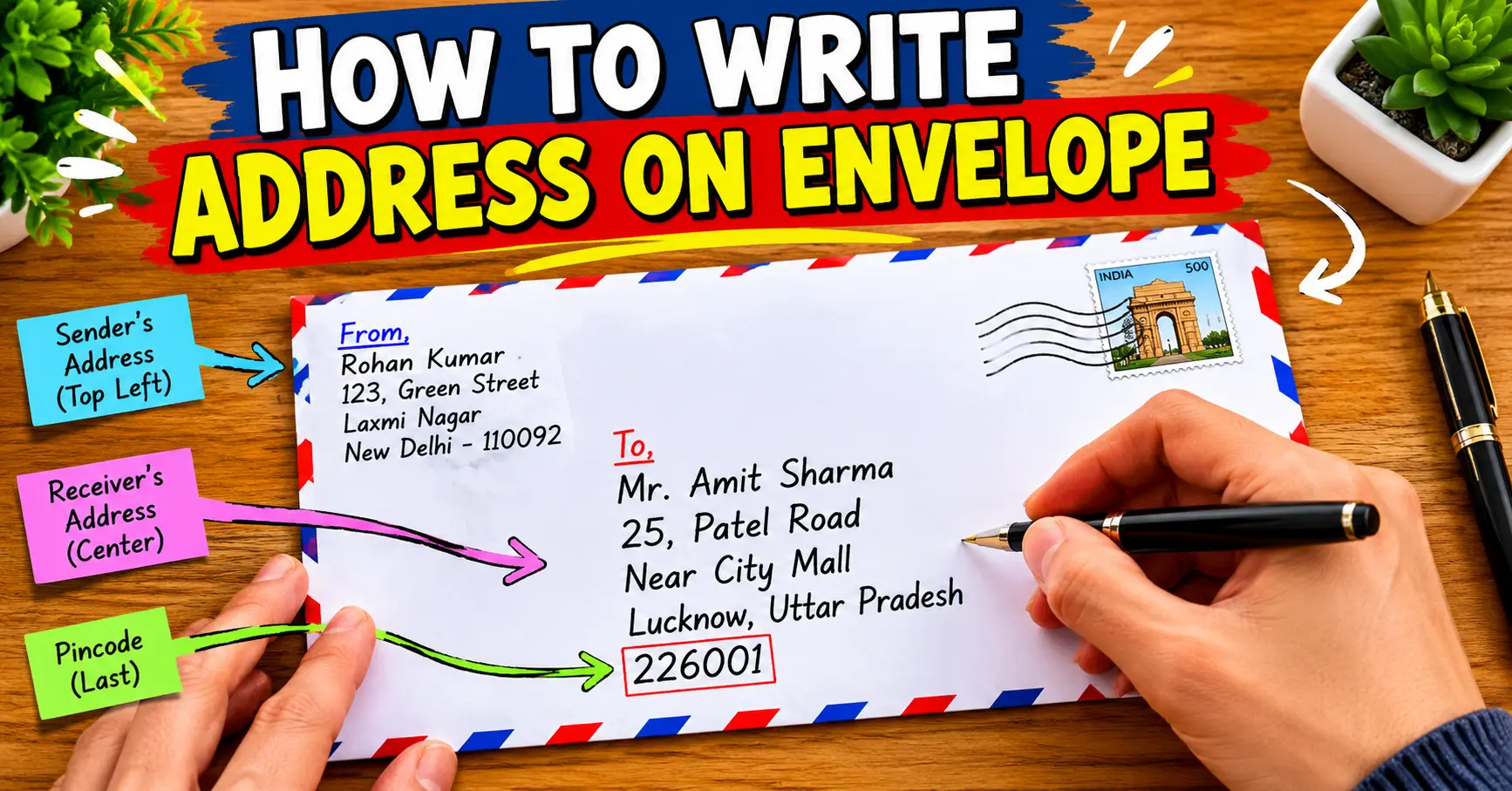
How to write address on envelope sending a letter sounds simple until you are standing at the mailbox wondering if you wrote everything in the right place. A missing apartment number or an illegible ZIP code is all it takes for your mail to end up at the wrong address or come back to you.
This guide covers everything you need: where each part of the address goes, how to format it for USPS machines, what to do for international mail, and the common mistakes most people never think about.
What You Need Before You Start

Before you write a single word on the envelope, gather the following:
- The recipient’s full name and complete mailing address including ZIP code
- Your own return address
- A blue or black ink pen or a printed label
- The correct postage stamp or postage amount
Use blue or black ink only. USPS automated sorting machines scan addresses using optical character recognition. Light ink, pencil, or decorative colors can confuse the scanner and delay your mail.
The Three Zones of an Envelope
Every properly addressed envelope has three distinct zones. Knowing where each zone is keeps your mail moving quickly through the postal system.
- The top left corner is for your return address
- The center of the envelope is for the recipient’s delivery address
- The top right corner is for the postage stamp
Keep these zones clear and uncluttered. Do not write anything in the bottom right corner either. USPS sorting machines print a barcode there to route your mail. Writing or drawing in that area can block it.
How to Write the Recipient’s Address
The recipient’s address goes in the center of the envelope both horizontally and vertically. This is the most important part because it tells the postal system exactly where to deliver your mail.
Write it on three or four lines in this order:
Line 1: Full name of the recipient Line 2: Street number and street name including apartment or suite number Line 3: City, state abbreviation, and ZIP code
Here is an example of the correct format:
Sarah Mitchell 742 Evergreen Terrace Apt 3B Springfield IL 62704
A few important formatting rules from USPS:
How to Look Up a ZIP+4 Code
Most people only know the five-digit ZIP code. The ZIP+4 adds four extra digits that pinpoint a specific block or building. You can find it free on the official USPS ZIP Code Lookup tool at usps.com. Enter the full street address and it returns the exact ZIP+4 for that location.
How to Write the Return Address
Your return address belongs in the top left corner of the envelope. It tells USPS where to send the letter back if it cannot be delivered. While USPS does not require a return address for domestic mail, leaving it off is a risk. If your letter is undeliverable and there is no return address on it, USPS sends it to the Mail Recovery Center where it may be held or discarded.
Format your return address the same way as the recipient’s address:
Your Full Name Your Street Address and Unit Number Your City, State ZIP Code
Write it slightly smaller than the recipient’s address so there is no confusion about which address is the destination.
Do not place your return address on the back flap of the envelope. Some people do this by habit but postal clerks have to flip the envelope over to read it, which slows down processing.
Where to Put the Stamp
The stamp or postage goes in the top right corner of the envelope at least one quarter inch from the top and right edges. If you are printing postage from a service like Stamps.com or USPS Click-N-Ship, the printed label goes in the same location.
How to Write the Address for Apartment Buildings and Multi-Unit Properties
This is where many people make mistakes. If the recipient lives in an apartment, suite, or unit, include that information on the same line as the street address, not on a line by itself.
Correct: John Reeves 1200 Oak Street Apt 5C Austin TX 78701
Not recommended: John Reeves 1200 Oak Street Apt 5C Austin TX 78701
The second version can confuse automated sorting systems because USPS machines read addresses from the bottom up, starting with the city, state, and ZIP code. If the apartment number appears below the street address, the machine may misread the delivery point.
How to Address Mail Sent to a Business
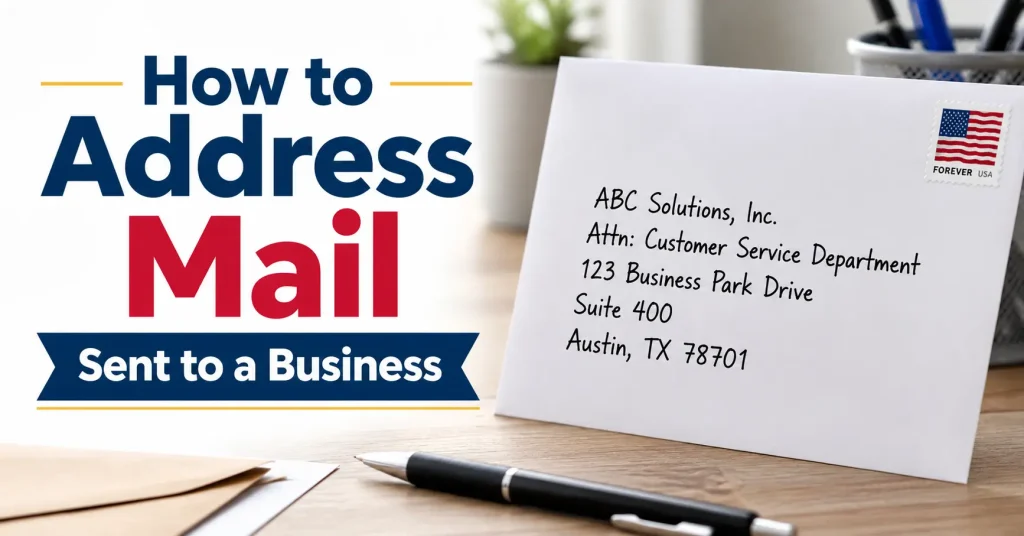
When sending mail to a specific person at a company, write the company name on the line above the recipient’s name or use “ATTN” to draw attention to the correct recipient.
Format option one: Acme Corporation ATTN: David Park 500 Commerce Blvd Suite 200 Chicago IL 60601
Format option two: David Park Acme Corporation 500 Commerce Blvd Suite 200 Chicago IL 60601
Both formats are acceptable: The key is that the street address and city, state, ZIP code appear on the last lines before the destination so postal machines can read them correctly.
How to Address an Envelope with Titles and Formal Names
Getting a person’s title right shows respect and ensures the letter reaches the right hands.
Here are the standard formats for common situations:
Single person (male): Mr. James Hart Single person (female): Ms. Laura Cole Married couple with same last name: Mr. and Mrs. James Hart Married couple with different last names: Mr. James Hart and Ms. Laura Cole Doctor: Dr. Patricia Nguyen or Patricia Nguyen MD Military personnel: Use their rank followed by full name (SGT Michael Torres) Families: The Hart Family
For formal occasions like wedding invitations, write out full names without abbreviations where possible. Spell out “Doctor” and “Professor” in full for very formal correspondence.
How to Address an Envelope for PO Boxes
Some recipients only receive mail at a PO Box. In that case, replace the street address line with the PO Box number. Do not include both a street address and a PO Box. USPS will use the line directly above the city and state to determine delivery, so whichever address appears last before the city line is where the mail will go.
Correct: Thomas Brady PO Box 1147 Denver CO 80202
How to Address an Envelope to Another Country
International mail requires a slightly different format. The country name must appear on the last line in capital letters. Write the rest of the address in the format used by that country, not the US format.
For a letter going to Canada:
Emily Clarke 47 Maple Avenue Suite 3 Toronto ON M5H 2N2 CANADA
A few tips for international mail:
- Write the country name in English even if the destination country uses a different language
- Check whether the destination country places the postal code before or after the city name
- Attach any required customs forms for packages
- Apply an airmail sticker if required by the service you are using
Addressing an Envelope When Writing by Hand
Handwriting an address looks personal and thoughtful but it introduces the risk of illegibility.
Here is how to keep your handwritten envelope looking clean and professional:
- Use a ruler and a light pencil to draw guide lines across the envelope before writing
- Write the full address in pencil first, then trace over it in ink
- Once the ink is completely dry, erase the pencil lines
- Print in block letters rather than cursive for best machine readability
- USPS strongly prefers printed or typed addresses over handwritten cursive for automated processing
Addressing an Envelope on a Computer or Printer
Most word processing programs including Microsoft Word and Google Docs have a built-in envelope template under the Mailings or Tools menu. You enter the return address and delivery address, select the envelope size, and print directly onto the envelope.
Tips for printing:
- Select the correct envelope size in the print settings before printing (standard US letter envelope is a Size 10 at 4.125 x 9.5 inches)
- Do a test print on plain paper first to confirm the address lands in the right position
- Use a dark font on a light or white envelope for maximum contrast and scannability
- Avoid decorative or script fonts on the address lines
USPS Official Rules for Addressing Envelopes
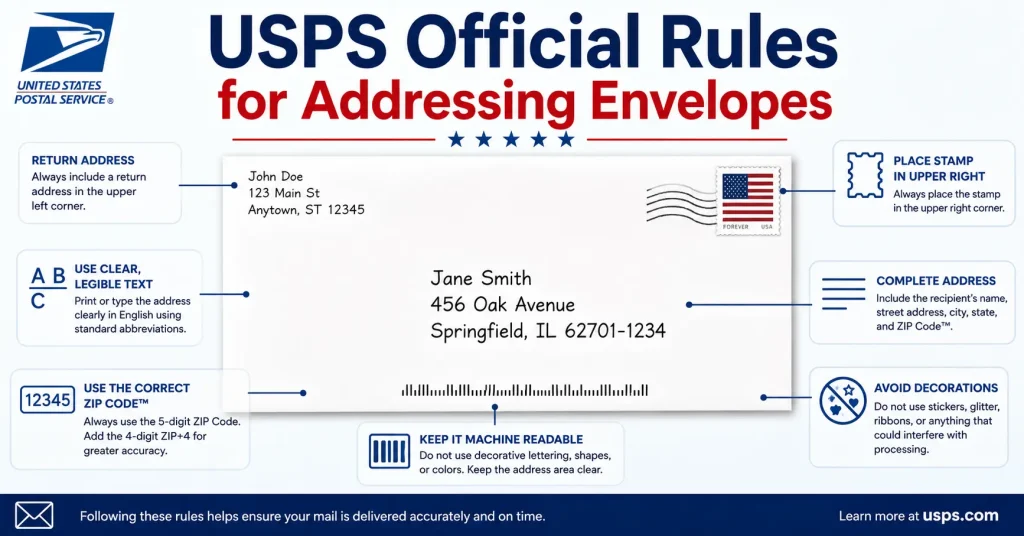
The United States Postal Service has specific guidelines that help its automated equipment process millions of pieces of mail every day.
Following these rules helps your mail move faster:
- Write or print in dark ink on a light background
- Use all capital letters for the city, state, and ZIP line
- Avoid punctuation except for a hyphen in ZIP+4 codes (example: 62704-1234)
- Do not use nicknames on formal mail
- Include apartment or suite numbers on the street address line
- Leave the bottom right area of the envelope clear for postal barcodes
- Make sure the address area has enough contrast to be scanned
Common Mistakes and How to Avoid Them
Most returned or lost mail comes down to a handful of avoidable errors:
Forgetting the apartment number: This is the most common cause of misdelivery in multi-unit buildings. Always include the unit number on the street address line.
Writing an outdated ZIP code: ZIP codes change occasionally when cities redraw postal boundaries. Use the USPS ZIP Code Lookup to verify before mailing.
Putting the return address on the back: As mentioned earlier, keep the return address on the front top left corner where postal equipment can read it without turning the envelope over.
Using pencil: Pencil can smear and fade during mail handling. Always use ink.
Skipping the return address entirely: If your letter is undeliverable with no return address, it goes to the Mail Recovery Center and you may never get it back.
Writing in the barcode clear zone: The bottom one inch of the envelope front is reserved for postal barcodes. Keep it blank.
Using a pen color that matches the envelope: Dark ink on a light envelope is the standard. Red ink on a red envelope will not scan.
Quick Reference: Standard US Envelope Address Format
Return Address (top left): YOUR NAME YOUR STREET ADDRESS APT NUMBER YOUR CITY ST ZIPCODE
Recipient Address (center): RECIPIENT NAME STREET ADDRESS APT OR SUITE NUMBER CITY ST ZIPCODE
Postage (top right): Stamp or printed postage label
FAQs
Where should the return address go on an envelope?
The return address should be written in the top-left corner of the front side of the envelope.
Where do you put the recipient’s address on an envelope?
The recipient’s address should be placed in the center of the envelope, slightly below the middle.
How do you address an envelope for international mail?
Include the recipient’s full address and write the destination country name in capital letters on the last line.
Should I use abbreviations in an envelope address?
Yes, standard postal abbreviations for states, provinces, and street types (such as St., Ave., and Rd.) are generally acceptable.
Can I write an envelope address by hand?
Yes, handwritten addresses are acceptable as long as they are neat, clear, and easy to read.
What color ink should be used when writing an envelope address?
Black or dark blue ink is recommended because it provides the best readability for postal services.
What happens if an address is written incorrectly on an envelope?
An incorrect address may delay delivery or cause the mail to be returned to the sender.
Final Thought
Knowing how to write address on envelope correctly can help ensure your letters, documents, and packages reach their destination without unnecessary delays. By placing the recipient’s address in the center, adding a clear return address, and following standard postal formatting guidelines, you can avoid common mailing mistakes. Whether you’re sending personal correspondence, business mail, or international letters, taking a few extra moments to address your envelope properly can make the delivery process smoother and more reliable.
