
what time was It 24 hours ago Understanding what time it was 24 hours ago sounds simple at first, but when you actually think about it, it connects to important ideas like time zones, clocks, calendars, and how humans measure time. In daily life, we usually just subtract 24 hours and assume it is the same time yesterday. In most cases, that is correct—but there are some interesting details that make this topic more meaningful than it appears.
In this article, you will learn exactly how to calculate the time 24 hours ago, how time zones affect it, why sometimes it is not exactly the same clock time, and real-life examples to make everything easy to understand
Understanding the Basic Idea of 24 Hours Ago
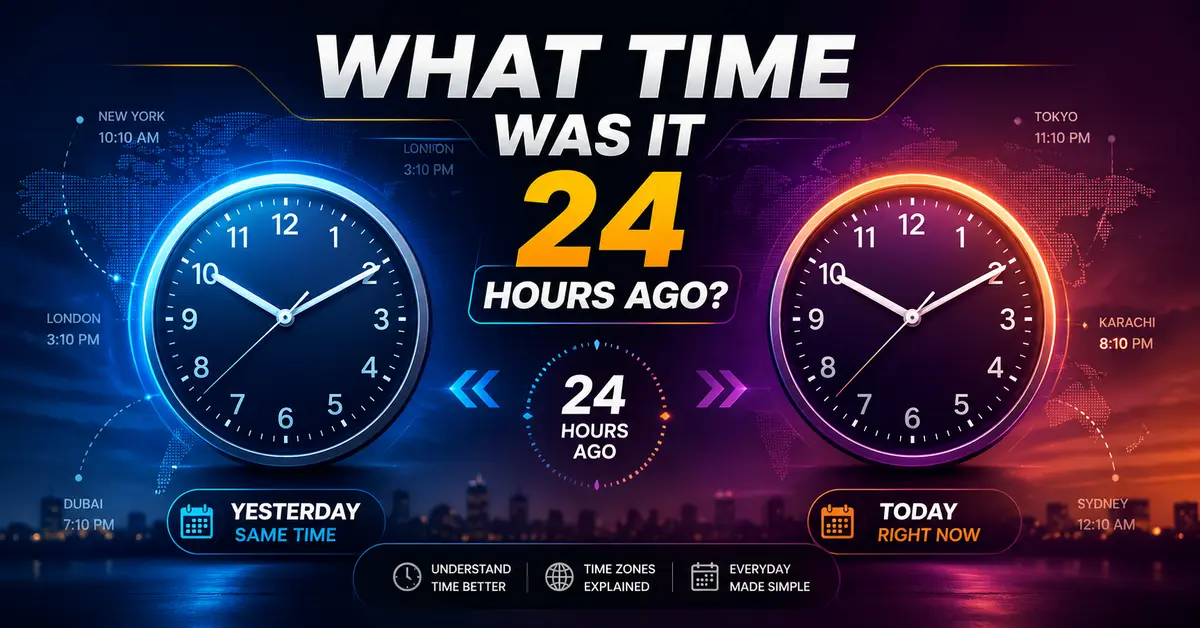
A day is commonly defined as 24 hours So when someone asks
What time was it 24 hours ago?
The simplest answer is:
It was the same time on the previous day
For example:
- If it is 3:00 PM today then 24 hours ago it was 3:00 PM yesterday
- If it is 9:15 AM now then 24 hours ago it was 9:15 AM yesterday
This works because clocks are designed to measure time in repeating 24-hour cycles.
However, while this seems straightforward, real-world time is influenced by geography, time zones, and even seasonal clock changes.
Why 24 Hours Ago Is Usually the Same Time
The Earth rotates once every approximately 24 hours. This rotation creates day and night. Because of this natural cycle, humans created a system where one full rotation equals one full day.
So when we say “24 hours ago,” we are essentially going back one full Earth rotation.
That is why:
- The hour stays the same
- The minute stays the same
- Only the day changes
For example:
- 7:30 PM today → 7:30 PM yesterday
- 12:00 AM today → 12:00 AM yesterday
This makes time calculations very easy in most daily situations.
The Role of Time Zones
Things become more interesting when we talk about time zones.
The Earth is divided into different time zones because different parts of the world experience daylight at different times. For example:
- Pakistan follows Pakistan Standard Time (PKT)
- The United Kingdom follows Greenwich Mean Time (GMT) or British Summer Time (BST)
- The United States has multiple time zones
What this means for 24 hours ago
If you are in Karachi, Pakistan:
- 24 hours ago in Karachi time = same time yesterday in Karachi
But if you compare across countries:
- 24 hours ago in Pakistan is NOT the same moment in London or New York
- Because their clocks are set differently
So while the concept remains simple locally, globally it becomes more complex.
Example Based on Pakistan (Simple Explanation)
Let’s say the current time in Karachi is:
- 6:00 PM (today)
Then:
- 24 hours ago = 6:00 PM (yesterday in Karachi)
But if someone in London checks the same moment:
- Their local time will be different because London is behind or ahead depending on daylight saving.
This shows that 24 hours ago is always based on your local clock.
What About Daylight Saving Time?
Some countries adjust their clocks during certain months. This is called Daylight Saving Time (DST).
During DST:
- Clocks are moved forward by 1 hour in summer
- Then moved back in winter
Because of this:
- 24 hours ago may not always feel exactly the same in terms of sunlight or schedule
- But mathematically, it is still the same clock time
For example:
- If DST changes occur between today and yesterday, the clock difference might feel unusual
- But the system still counts it as 24 hours
Simple Formula to Calculate 24 Hours Ago
There is actually no complicated formula needed, but you can think of it like this:
Current Time – 24 Hours = Time 24 Hours Ago
In real terms:
- Subtract 1 full day
- Keep the same hour and minute
- Change only the date
Example:
- Today: 10 March, 4:45 PM
- 24 hours ago: 9 March, 4:45 PM
Why People Ask This Question
You might wonder why people even search for this.
Here are some common reasons:
Tracking events
People want to know when something happened yesterday.
Work or deadlines
Businesses often check logs or records from exactly 24 hours ago.
Security logs
Servers and apps record activity based on time stamps.
Travel and scheduling
Flights, meetings, and international communication depend on accurate time calculation.
Common Confusion About 24 Hours Ago
Even though the concept is simple, people often get confused. Let’s clear up some misunderstandings.
Mistake 1: Thinking it changes the hour
Some people think 24 hours ago means a different hour. It does not. It stays the same hour and minute.
Mistake 2: Forgetting date change
The only thing that changes is the date, not the time.
Mistake 3: Ignoring time zones
When comparing two countries, people forget that “24 hours ago” depends on local time.
How Computers Calculate 24 Hours Ago
Digital systems like mobile phones and computers use something called timestamps.
A timestamp is a precise record of:
- Date
- Hour
- Minute
- Second
When you ask a system “what was the time 24 hours ago,” it:
- Takes the current timestamp
- Subtracts exactly 86,400 seconds (24 × 60 × 60)
- Shows the result
This makes it extremely accurate and consistent.
Real-Life Example
Let’s take a real-life scenario:
You are in Karachi, and the time is:
- 11:20 AM on April 30
Now, 24 hours ago:
- It was 11:20 AM on April 29
That’s it. No changes in hour or minute.
But if you were talking to someone in another country, their local time might show a different clock reading for the same moment in history.
Why Understanding Time Matters
Time is one of the most important measurements in daily life. Knowing how to calculate “24 hours ago” helps in many areas:
Business
Companies track performance daily.
Education
Students calculate durations in assignments.
Technology
Apps and systems rely on precise time tracking.
Personal life
People track sleep, routines, and habits.
Understanding time properly helps avoid mistakes and confusion.
A Deeper Look Time Is Not Always Simple
Even though we say a day is 24 hours, the Earth’s rotation is not perfectly exact every single day. There are very small variations. However, for everyday life:
- We always treat a day as 24 hours
- This keeps everything simple and practical
So when you calculate “24 hours ago,” you are using a standardized system, not exact astronomical measurement.
Summary
To summarize everything in a simple way:
- 24 hours ago means exactly one full day before the current time
- The hour and minute remain the same
- Only the date changes
- Time zones affect global comparison
- Computers calculate it using seconds
- In everyday life, it is a very simple and useful concept
Final Thoughts
The question “What time was it 24 hours ago?” looks very easy, but it connects to the deeper structure of how humans measure time. From Earth’s rotation to global time zones and digital clocks, everything works together to keep time organized.
If you understand the basic idea that 24 hours equals one full day, you can easily calculate it in any situation without confusion.